The Manual for the Perfect Project
December 2025
Projects are like arranged marriages. They begin with a tense smile and the vague promise of eternal happiness. Then one discovers that Prince Charming grinds his teeth in his sleep and the princess has a maniacal collection of porcelain dolls. In short: the theory is lovely; the practice, a succession of small adjustments to reality. Or, as they say in modern parlance, "managing expectations."
Here are the ten capital sins of the client (and their respective penances), described not as cold entries in a manual, but as episodes from the human soap opera that is doing anything with anyone else.

1. The Just-One-More-Tiny-Thing
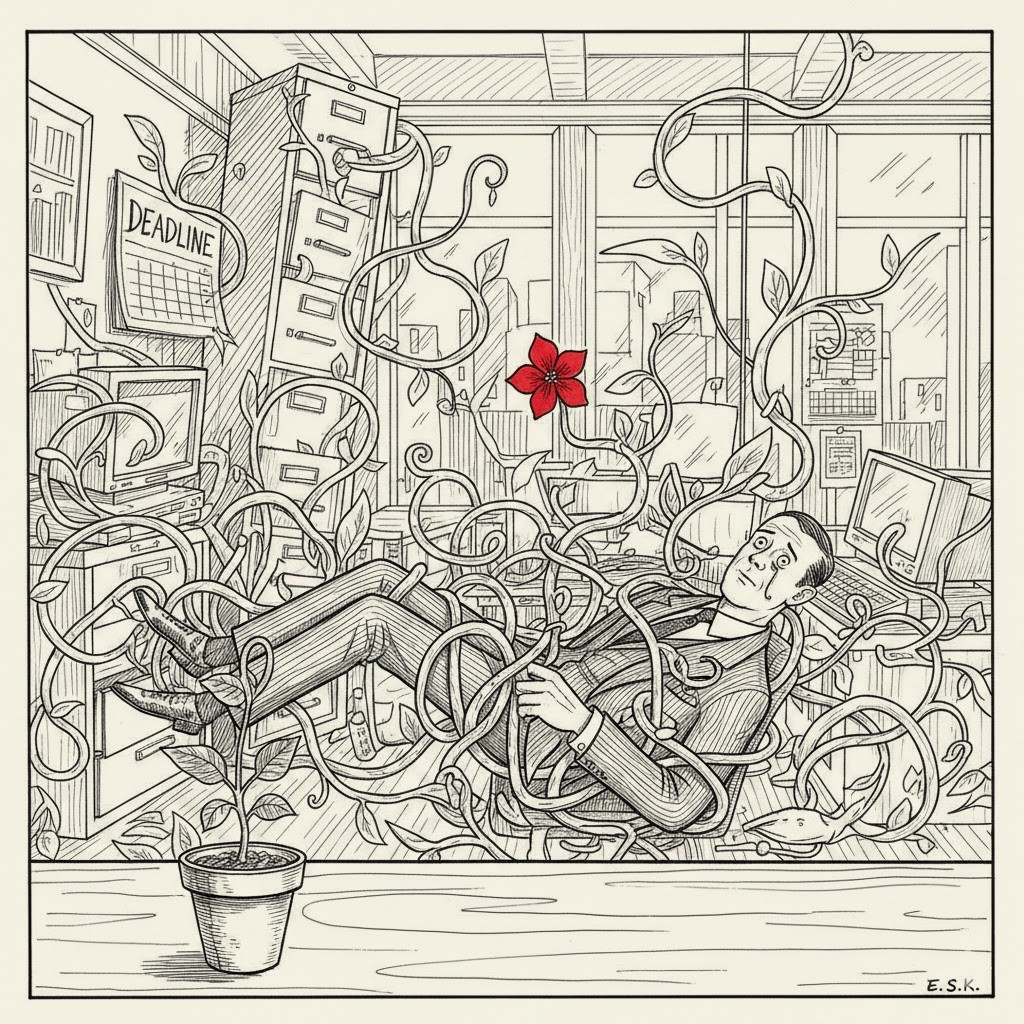
Definition: The silent killer. It's an innocent request, a discreet supplement, a "while you're at it..." that, cell by cell, corrodes the skeleton of the project until only a misshapen heap of tasks remains, impossible deadlines and a budget in a coma.
Early Warning Signs: Phrases beginning with "While you're there...", "It would be cool if also..." or the classic "This is quick, isn't it?" The tone is always one of lightness, like someone asking for a glass of water.
Prevention: A contract isn't a detective novel, but it should read like one. The scope must be as detailed as the description of a watch in a Georges Simenon novel. Any new element is a Change Request – a formal ceremony, with signatures and consequences, like altering the route of a train.
"A contract isn't a detective novel, but it should read like one."
Remediation: Stop the world. Nothing moves until the new world is drawn, budgeted and calendared. Communicate the impact with the raw clarity of a weather bulletin: "This will cost X and delay Y. Do you wish to proceed?"
2. The Shifting Requirements
Definition: The client suffers from romantic indecision. Falls in love with a feature on Monday, falls out of love on Tuesday, and by Wednesday is flirting with another completely opposite one. The project becomes a sentimental drama.
Signs: Last week's briefing is today treated as an embarrassing misunderstanding. The words "definitive" and "approved" have the shelf life of yogurt.
Prevention: Conduct exhaustive workshops at the beginning, like long pre-marital interviews. Create rough and cheap prototypes to fail fast and cheap. Freeze requirements in documents with the formal weight of a constitution.
Remediation: Each new whim (or insight) generates an annexed document: "Amendment No. 47: Impact." The client chooses: it's crucial and pays the price, or it's postponed to "Version 2.0," that utopian heaven where all good ideas go to live.
3. The Crushing of Deadlines
Definition: The initial calendar, once respected as a gentleman's agreement, is suddenly seen as a flexible suggestion. The final date shrinks like a wool jumper in the washing machine.
Signs: The phrase "It needs to be done for yesterday" is uttered without irony. New "windows of opportunity" emerge that demand chronological miracles.
Prevention: Show the anatomy of time. A chart with dependencies, hours and resources is more powerful than a thousand speeches. Establish, right from the start, the physical law of the project: Deadline, Cost, Quality – choose two.
Remediation: Present the new menu of options: "To have it by week 24, we must remove A, B and C. Or we keep everything and deliver in week 32. Which do you prefer?" The choice is the client's, but the arithmetic is yours.
4. The Decisional Paralysis
Definition: The moment of approval, which should be a crisp click, transforms into a swamp of revisions, hesitations and silences. The project drifts, waiting for wind.
Signs: Emails that echo in the void. The phrase "I'll consult someone" becomes the project's motto. The feedback meeting ends with a "it's almost there, just a few tiny adjustments."
Prevention: Stipulate approval deadlines in the contract. "Silence means consent" is a mental health clause. Use tools that expose whose court the ball is stuck in.
Remediation: Communicate, with sweetness and firmness, that the train cannot always be at the station. After the deadline, tacit approval applies and we depart for the next station. If the indecision is chronic, escalate to whoever has the key to the cage of decisions.
5. The Micromanagement: The Client Engineer
Definition: The client, dissatisfied with the passenger seat in the locomotive, invades the cabin and tries to drive, shovel the coal and blow the whistle. The team becomes a choir of puppets.
Signs: Daily progress reports, requests to "see how it's coming along" every 3 hours, suggestions about the colour of a pixel.
Prevention: Establish, right from the outset, the cadence of communications: "We give news every Friday." Reaffirm roles: "You tell us what and *why*. We tell you *how* and *when*."
Remediation: Present the plan with the authority of a doctor. "According to our methodology, the next step is X. We meet on Friday to show the results." Reduce noise, increase signal. Limit contact points to one person – the project manager – the official translator between two tribes.

6. The Dance of Payments
Definition: Money, which should flow like a tranquil river after each milestone, becomes a rare geological phenomenon. Payments are "being processed," "in accounting," "going out tomorrow." They're the ghosts of the project: everyone talks about them, nobody sees them.
Signs: The silence after the invoice. The unanswered email. The phone call that goes straight to voicemail. The classic "I'll send it this afternoon" at 16:59 on a Friday.
Prevention: Money up front isn't mistrust, it's common sense. Associate work milestones with payment milestones, with a simple rule: "We don't advance to the next milestone without the financial *okay* of the previous one."
Remediation: Stop. With the delicacy of a bus driver who parks for lack of fuel. Formally communicate that work is suspended until regularisation. Apply, without hesitation, the anticipated penalties. The game must end at the first instance.
7. The Leapfrog of Priorities
Definition: The project's roadmap is crossed out and redrawn with the frequency of a doodle on the margin of a phone call. What was crucial on Monday is trivial on Tuesday. The team lives in a state of permanent vertigo.
Signs: The backlog resembles a punk band's rehearsal notebook. The phrase "forget what we agreed, now the most important thing is..." is said more than once per sprint.
Prevention: Freeze priorities by cycles (e.g., a 2-week sprint). "In these two weeks, we do this. We only change at the next station."
Remediation: Educate with patience. "If we bring in task Y now, task X, which was your absolute priority, goes out. Confirm?" Record each change and its cost in time. Transform the capricious "novelty" into the serious "change request."
8. The Pressure of Contempts
Definition: The client, moved by touching optimism (or by a fierce desire to lower the price), describes the work as something that "can be done in a flash." Complexity is minimised, effort is ridiculed.
Signs: The word "simple" is abused. "That's easy for you." "A *stripe* here, a social *login* there – can't be much work."
Prevention: Budget based on task decomposition and hours, not on hunches. Define an MVP (*Minimum Viable Product*) so minimum it costs what's fair and does what's essential.
Remediation: When the "simple little thing" reveals its claws and teeth, present the data. "For this 'little thing,' we need 40 hours of development, 8 of testing and 4 of integration. This changes the budget by X. How do we proceed?"
9. The Trap of Informality
Definition: The swampy terrain where corridor "arrangements," WhatsApp messages and the "oh, by the way..." of meetings gain the status of sacred contract. The official project lives in a document; the *shadow* project lives on the boss's mobile phone.
Signs: The phrase "But you agreed on Teams!" said with indignation. Screenshots of conversations used as evidence in court.
Prevention: The golden rule: "If it's not written down, it doesn't exist." Follow all informal conversations with a confirmation email: "According to our conversation, we agreed thus... Confirm?"
Remediation: When the informal *bandit* emerges, smile and say: "Of course I can look at that. To formally integrate it into the project, I need you to send me an email requesting it, so I can calculate the impact and we can adjust the contract." Transform the murmur into a declaration.

10. The Eternal Feedback (or The Revision of Death)
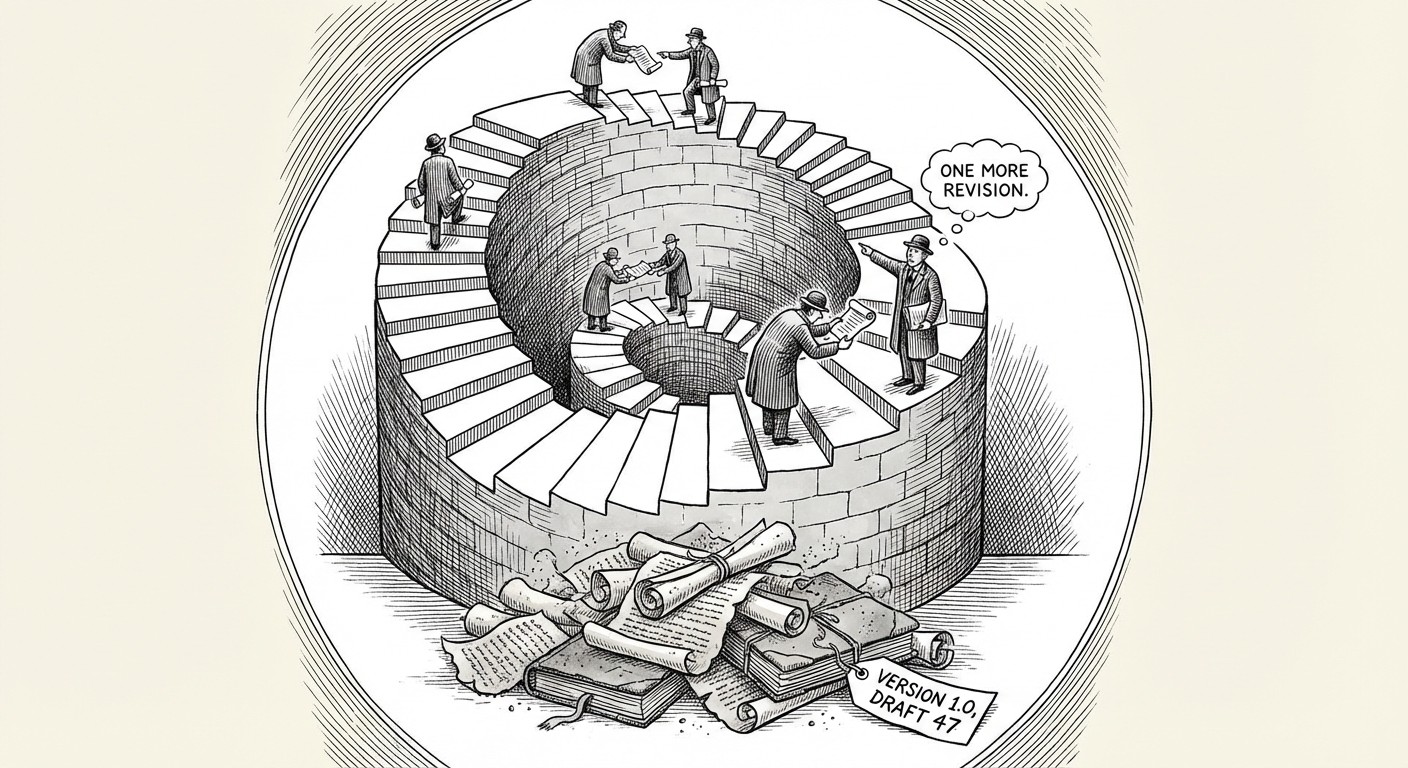
Definition: The *feedback* phase, which should be a finite process of refinement, becomes a purgatory of subjective opinions and belated new *insights*. Delivery is never declared complete, only abandoned through exhaustion.
Signs: New comments emerge on versions thought to be archived. The request for "one last look" is recurrent. There is no clear criterion for "it's good."
Prevention: Limit the number of revision rounds in the contract (e.g., two revisions included). Define a clear process: "I send for approval → You gather *feedback* in a document → We implement → You resend for final *okay*."
Remediation: After the included rounds, smile and invoice. "Changes requested in round 3 will be budgeted separately." If silence settles after sending, apply the tacit approval clause and declare the milestone closed. Perfection is the enemy of done.
In summary, dear reader, managing a project is less about *Gantt charts* and more about psychology, less about *software* and more about *soft skills*. It's the art of transforming potential chaos into negotiated order, of protecting work from destructive enthusiasm, and of reminding all involved that a great project is one that ends – with quality, on time and with the business intact.
In the end, it's making the arranged marriage work out, not in divorce, but in a happy and productive partnership. Or, at the very least, in a civilised truce that allows both parties to move on to the next battle with renewed hopes and better-written contracts.